Days 94-97: The Big Fire | You Wouldn’t Want Me As Your Village Bard | The Stream | The Kids Are All That Matters

Earlier this year my friend Mairi Gillies made an exhibition for An Lanntair that’s been stuck in my head for a while now. I wrote a song inspired by it, The Big Fire

The exhibition was called Uaim an Òir and was inspired by an old story about a piper who goes into a cave and disappears. There are various versions of this story; the common theme is that, in Gaelic culture, caves represent a gateway to the ‘otherworld’. They were also somewhere musicians could secretly play an instrument that had been forbidden by church elders. In other words, they’re places of creativity, magic and rebellion. What’s not to like?

On a basic, instinctive level I loved Uaim an Òir. When it comes to art I’m generally much more excited about things that transform a whole space than things in frames, and this show felt like it was growing organically out of the walls. I also love caves – their look, texture and sound. In fact I’d just written a song about sea caves when I went to Mairi’s show. 

If I’m honest though I also felt at an emotional distance from it. In the exhibition notes Mairi describes Uaim an Òir as “a meditation on how we are born and shaped by the landscapes we are rooted to, the places and spaces we inhabit, and the history and culture embedded in these”, from a Gaelic perspective. But I’ve always felt a bit rootless. I’m half English but repelled by most ideas of ‘Englishness’ (and, like a lot of people, disturbed by the current ‘patriotic’ revival of the English flag). I’m also half Scottish, but didn’t grow up in Scotland so don’t feel I can claim that part of my identity as my ‘roots’, especially when Scotland often seems to define itself by its difference from Englishness (ie: half of me). And Gaelic identity is a different thing from Scottish identity anyway. So I felt drawn to this exhibition in the same way that I’m drawn to Alastair McIntosh’s Soil & Soul (a book I love with which it shares some themes) but also on the outside of it. 

It bothers me that this bothered me. Why should a show about Gaelic culture, by a Gaelic artist, have to pander to a non-Gael? And who wants to live in a monoculture where everyone can identify with everything anyway? I don’t, and there’s plenty of art that I love precisely because it’s a window into a world that’s unlike my own. But sometimes the small differences, the small experiences of outsider-dom, can register most strongly. To pick a random comparison, I love Rye Lane, a comedy about two Black  twentysomething Londoners falling in love on a day-long caper around the city. The film is a fantastically vivid picture of a specific place and time and culture, and while I’m at a distance from it on numerous levels – I’m not Black, I’m not in my twenties, and I’ve never lived in London or the kinds of social circles the characters live in – this didn’t bother me at all. If anything I liked it all the more for that, and besides there are plenty of things in it – love, most obviously – that anyone can connect with emotionally. But for some reason my distance from Uaim an Òir does bother me.

I think I know what’s going on here. The first time I recorded an album in the Isle of Lewis I made a point of calling it Tourism. I wanted to acknowledge my outsider status and emphasise that, as an incomer, I wasn’t presuming to speak for an island and its culture. Seven years into Lewis life, though, the ‘tourist’ thing feels like a cop out. I’m a Hebridean artist now and I feel like I need to work out what that means and where I belong. And the fact is that Mairi, who didn’t grow up in Lewis either, is doing this better than me. She has embraced and explored Gaelic culture to the point where, despite being an incomer, she is increasingly regarded as a standard bearer for it. I, meanwhile, am still fumbling around, likening myself to a ‘tourist’, and feeling like I might need to do better.

Uaim an Òir was still on my mind when I wrote You Wouldn’t Want Me As Your Village Bard. The title refers to the old Gaelic tradition of village bard or village poet (bàrd-bhaile), who would – as I understand it – write in a traditional style about their community, preserving that tradition in the process. I certainly don’t feel qualified to do that, but I am the only songwriter in my village, so in that sense I am quite literally the village bard. Then again, maybe anyone with a social media account is a village bard now, representing their community in public in some way? So the song is me wondering how a specific old Gaelic tradition fits into the modern world, and what grants someone the right to speak for their community anyway. Is it a gift for storytelling, a deep understanding of the culture, the length of time you’ve lived there, or just who has the loudest voice? Maybe the real village bards are the local gossips who find power and status in knowing everyone’s business?

As a slightly solitary creature I’m nervous about writing in this way, and in two minds about whether to pursue it further, particularly given that I don’t speak Gaelic. I’ve heard it said that unless you speak Gaelic you will never fully understand Lewis and I’m sympathetic to this view (it’s true, for example, of the title of Mairi’s exhibition, a Gaelic play on words whose meaning will be completely lost on a non-Gaelic speaker). I feel on safer ground just singing about the landscape, like on The Stream, a song written in the early days of Covid-19 lockdown as I walked my dog up the hill above our village and realised that this small patch of land was mostly enough for me and that I had no desire to travel anywhere anyway (a position of incredible luck and privilege, I know, particularly back then).

I can also write about my children, who are Hebridean in a way that I may never be. I was fully formed by the time I got here but they are absorbing the culture without even thinking about it. The Kids Are All that Matters is a song about trying to keep your children safe at an increasingly frightening time in history, and about the vast gulf between the peace of a Hebridean village and a wider world of war, climate emergency, and authoritarianism. The connecting thread here is Donald Trump, the Isle of Lewis’s most infamous son. It’s very strange watching the impact he is having on the world from his old family home. My children’s friends include relatives of Trump – not that they have any contact with him – and there are ‘Shame On You, Donald John’ banners in windows across the island. In hindsight I wonder if I should have made that connection explicit in the song rather than just writing an oblique reference to ‘the mad men and their money’. Maybe that’s another song, or maybe that’s a job for a different kind of village bard.

Days 92-93: A Billion Stones | A Sea Cave

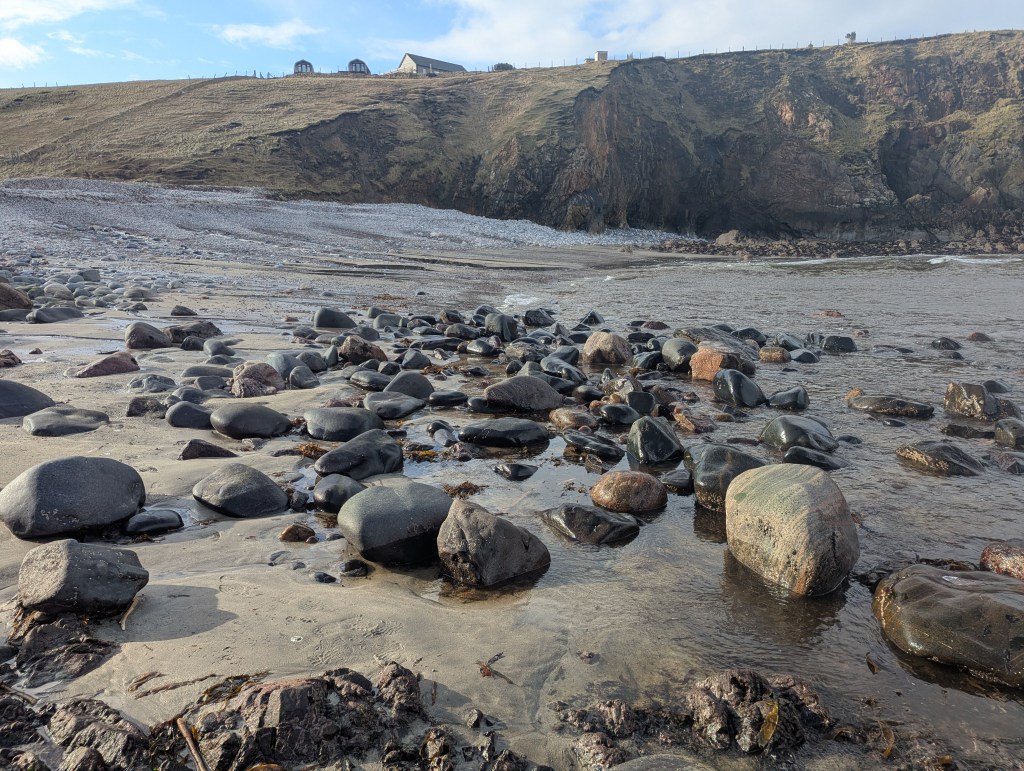
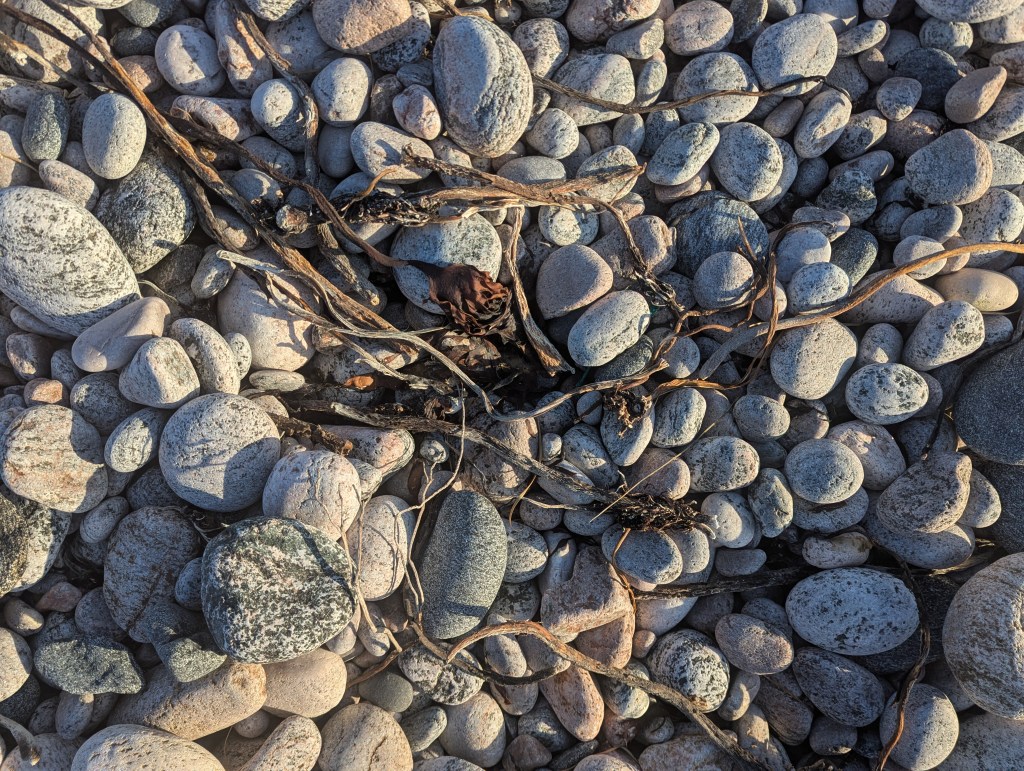
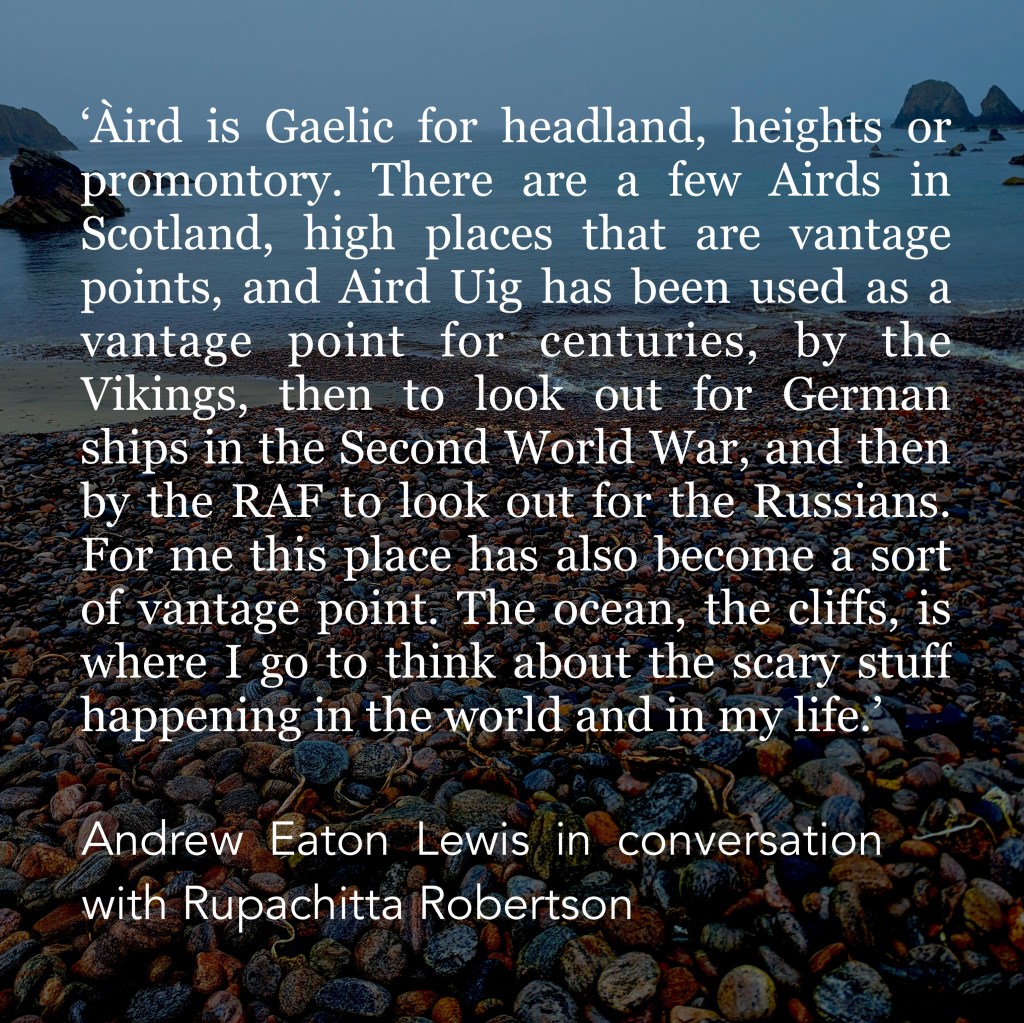
If you spend enough time somewhere, in different seasons and weather conditions, it becomes a multitude of places. I’ve stood on Aird Uig beach facing down winds so strong they’ve almost blown me over, the noise howling in my ears. I’ve listened to it from a distance at night, its millions of stones crashing and tumbling into each other as the waves batter into them in the dark. I’ve watched waterfalls flowing up the cliff in a gale. I’ve also sat on those stones on a perfectly calm and still day under a cloudless blue sky, examining them one by one, obsessing over how the colours and patterns resemble cloud formations on Jupiter. Most recently I’ve walked the beach during the lowest tides I’ve ever seen, discovering for the first time that Aird can be a sandy beach when the ocean allows it.

I could probably write dozens of songs about this beach. Since the beginning of 2025 I’ve written and recorded two, A Billion Stones and A Sea Cave, the first new music I’ve made after about a year and a half of not being able to write anything. I’m not exactly sure why this has happened now. I’ve been to this beach lots of times over the past six years so it’s hardly a new discovery, but it’s possible there’s a degree of familiarity and comfort with the place that wasn’t there before. Or it might just be because I now have the means to record music at home for the first time, which has helped motivate me to get my act together. Either way, there will be more new music soon. I’m currently working my way towards a new album of songs about the Isle of Lewis, with help from my old Swimmer One bandmate Hamish Brown. These two songs mark the beginnings of it.

A Billion Stones is about standing on the beach in the middle of the night under a clear sky full of stars. I did this again a few days ago. and it was the perfect night for it. No clouds at all. The Moon bright enough to light the way but not too bright to block out the Milky Way. The Aurora were out (much more brightly than captured in the photo above) but there was no wind, so the only sound was a billion stones invisibly rumbling and tumbling underwater as waves smashed into the shoreline a few metres from where I was standing.

Standing on these stones is humbling. They would once have been part of the cliff face that towers above each side of the beach, but over thousands of years the ocean gradually transformed them into what they are now. Walking on them, you have a powerful sense of the tininess of a human lifespan, a time during which this beach will barely change at all. That feeling is magnified at night, when you have ancient stones under your feet and much more ancient stars above your head – thousands of them clearly visible, thanks to the night sky in the Hebrides being darker than it is almost anywhere in Europe – and the only sound is the waves continuing to crash into the stones, nature doing its slow work. Standing on those stones also amplifies the precarity of human existence. This is not a beach where you can sink your toes into the sand, take a deep breath, relax, and reconnect reassuringly with nature. It’s an uneven, unsteady surface even on a calm, dry day, always moving underneath you. You need to be constantly alert otherwise you’ll fall over. And if you do fall it won’t be a soft landing.

If you spend any amount of time in Lewis you end up thinking about stone a lot. The island’s most famous landmark is the Calanais Stones, a breathtaking stone circle older than Stonehenge. Houses used to be made from stones collected from the moors and the remains of these houses can be found everywhere, along with dry stone walls, many of them hundreds of years old. There are cairns at the top of every hill. Across the island there are stone memorials designed by artist Will Maclean, commemorating land struggles from the late 19th and early 20th centuries. When the Scottish contemporary artists Dalziel + Scullion moved to Lewis recently, one of the first new things they made was a film they jokingly described to me as ‘a day in the life of a rock’. Partly it’s the obvious absence of trees that makes stone so prominent in the landscape, culturally as well as geographically, partly it’s that Lewis has some of the oldest stone in the world. The Calanais Stones are made from Lewisian gneiss, which is around three billion years old. The ancient people who built them were using materials far more ancient than them.

I’m not sure how well A Billion Stones captures any of this, but I was pleased enough with it that I made A Sea Cave almost immediately afterwards. Musically, this song began with a recording of water dripping from rocks on a part of Ardroil beach I’d never been to before because the tide had always been too high. I spend quite a lot of my time listening to water dripping from rocks (and have been known to record it before) but these drips were so much faster than those I’d heard before, like dance music in comparison, coming from four or five different places, the sounds all blending together. Around the same time I was thrilled to discover a small sea cave on Aird Uig beach that I hadn’t previously known was there, at the end of a gully of perfectly smooth, wave-blasted rock that’s underwater except at the very lowest of tides, and these two experiences merged together.

A Sea Cave isn’t really about that though. Finding that cave coincided with a series of losses. Initially I had a half-formed lyric about searching for a missing cat (a formerly feral kitten who spent most of its time outside, was constantly killing birds and rabbits, and who we suspect eventually picked a fight she couldn’t win, probably with an otter). It wasn’t much of a lyric, to be honest, but it took on a new layer of meaning when two people I knew from the same village then died within days of each other, a shocking event for a population of less than 30, especially since one of the deaths was sudden and completely unexpected. I attended two funerals in the same week, a first for me. Then, just a few days later, one of my wife’s horses unexpectedly had to be put down after the vet discovered a large tumour at the back of his throat, so far back that it had remained hidden from view probably for years. We had a funeral for the horse too, another sad day and another first for me (the task of burying something so big was another humbling experience). I built a gravestone from a pile of rocks taken from a nearby dry stone wall. And so A Sea Cave ultimately became a song about stones as memorials for living things. 

It’s possible I could have written a better, more considered lyric about all this if I’d spent more time processing it. But I’ve often thought that one of my flaws as a songwriter is a tendency to overthink and overcomplicate things, so with A Sea Cave – and A Billion Stones – I went with what were basically first drafts that, in the moment, seemed to have some emotional resonance. I suspect this decision will bother me more as time goes on, but the fact is I’ve gone from writing and recording absolutely nothing in 2024 to writing and recording most of an album in the space of a few weeks in 2025. So that’s progress, right?

Day 91: This is the Start

It’s a bit of a shock to reach the end of 2024 and realise I’ve not written a single song this year. The last song I managed to finish was This is the Start, released in January 2024 but recorded back in the summer of 2023. At the time it felt like a step towards something new but I don’t know now. It’d be a funny title for the last song I ever released if that was what it turned out to be.

I did learn a couple of lessons with This is the Start which I wish I’d learned earlier. The first was that if you call a song This is the Start then DJs will play it right at the start of their show. In this case, Roddy Hart and Tom Robinson both did, with Tom giving the song one of the loveliest, most enthusiastic endorsements I’ve had on BBC 6 Music. The other thing I learned – which really I knew already but was in denial about  – was that pop songs tend to work best if they’re explicitly about being young. I now wish I’d spent less time, when I was younger, trying hard to sound older and cleverer when I would probably have been better off leaning into my youth and naivety, both of which might have been more relatable.

I suspect that part of the reason I haven’t written anything new since 2023 is that the other three songs I wrote that year – Lights OutThe Stages and Do Your Worst – felt like a lyrical cul-de-sac, overly melancholy reflections on mortality and identity that I apparently needed to get off my chest as I turned 50.  If you can relate to that, great, and they’re all available as rough sketches on Bandcamp, but increasingly I was feeling like I should write about something else and also make music in a different way. Other than This is the Start though, I’ve still not figured out what that looks like over a year later.

It’s a bit ironic then that in 2023 and 2024 I’ve spent more time than ever in the company of other songwriters.

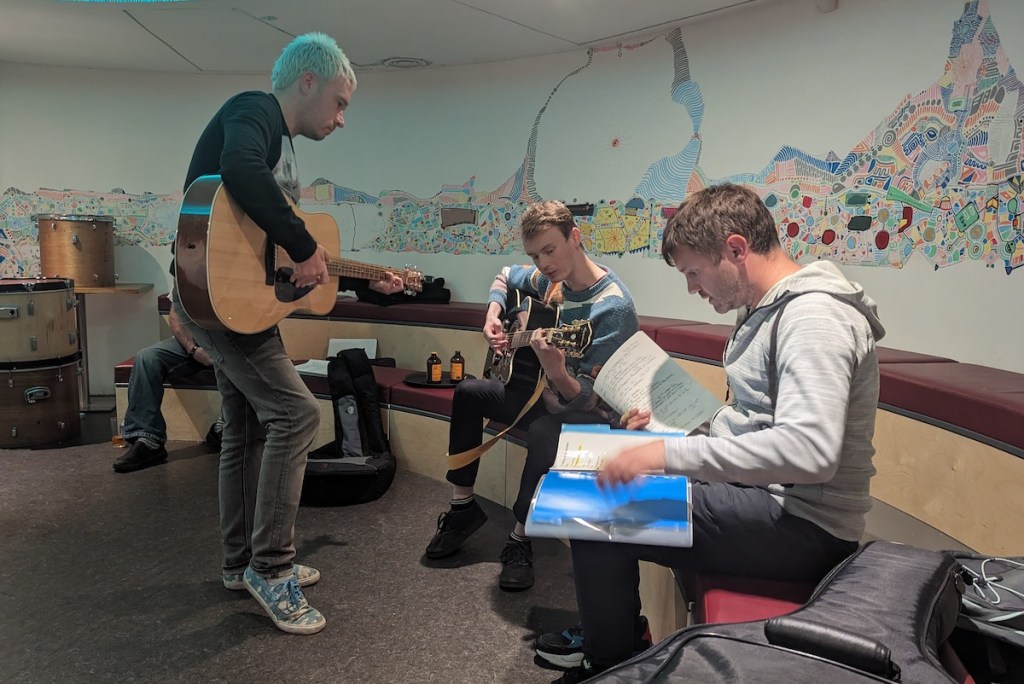
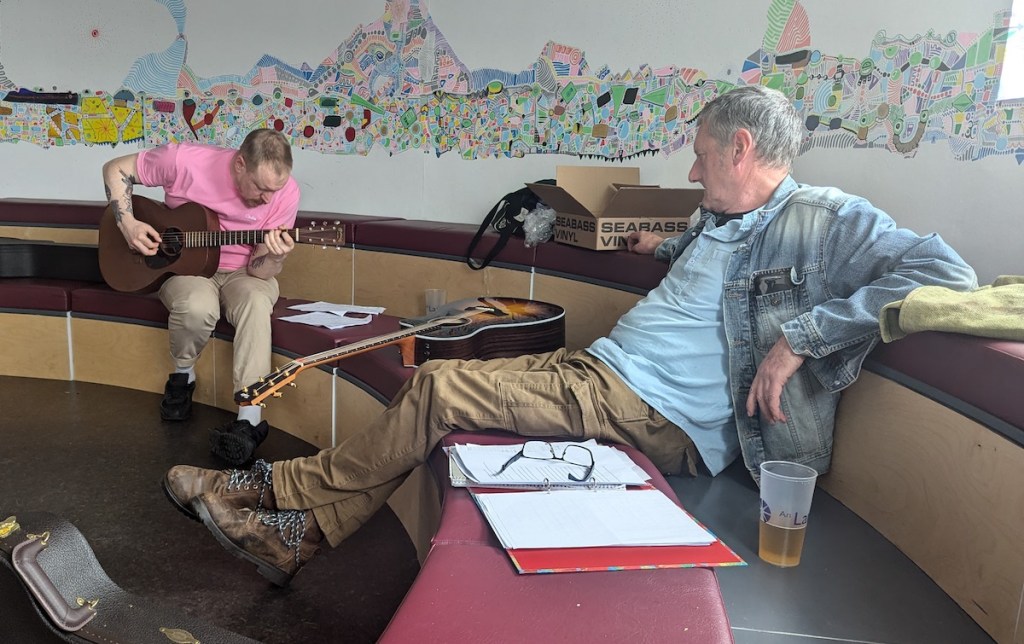
In July 2023 I began hosting a Songwriters Circle for An Lanntair as part of my job running the venue’s artist support programme. Every month I host a free gathering where Hebridean songwriters can share things they’ve been working on, often in an unfinished state, with no audience and no pressure to ‘perform’. We talk a lot about music we like and why we like it. In two years of doing this I’ve only shared one of my own songs a couple of times, and in each case it’s been something old. I keep hoping these get togethers will prompt me to write new music but they never do.

What they have done, though, is remind me that the songs we hear on the radio, YouTube or TikTok mostly aren’t getting that exposure because they’re better, melodically or lyrically, than the songs we mostly don’t hear. That exposure is the result of various elements coming together that often have nothing to do with the song itself. I’ve heard dozens of songs at our Songwriters Circle over the past couple of years that could get lots of national or international airplay in the right circumstances – the right producer, the right radio plugger, the right music video, or perhaps just the right singer, of the right age and background, wearing the right clothes, at the right moment in time.

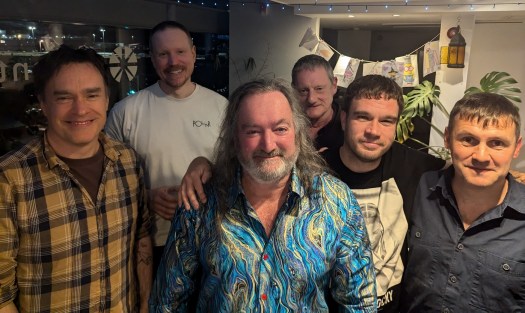
Our circle has a few regulars in addition to the various people who drop in and out. Here they are with me below – (left to right) Matthew Newsome, Martin Flett, Michael Winder, Richy McKendrick and Iain Smith – at Martin’s album launch in October 2024. I want to write about each of them in turn, because I’m currently more excited about their music than my own. 

The one I’ve worked with most is Martin Flett. Martin is a competitive powerlifter who began writing songs during the Covid-19 lockdown in 2020, has now written over 100, and just released his debut album at the age of 68. He’s an example to anyone who ever thought they’ve left it too late to be an artist.

Martin has a gift for writing songs that sound like they’ve been popular for 40 or 50 years, not just here but in the USA (one review described it as “the point where the Outer Hebrides meet Monument Valley”). When Martin plays them in Stornoway pubs, people are frequently shocked to realise that he wrote them because they sound so much like old favourites by Neil Young or Roy Orbison.

I mentored Martin through the artist support programme, which involved helping him to choose ten or 11 of his strongest songs to put on an album, deciding on a running order, and working on musical arrangements, all of which are among my favourite things to do. We recorded the album at Wee Studio with a band that included both established professional musicians like Colin Macleod (on drums) and studio first timers like Mary Suckling who Martin had heard singing in a pub. 

The album, aptly titled When The Introverts Come Out, is on sale now via Martin’s website. The music evokes a different time and so does the sales pitch. You can’t actually stream the whole thing online – Martin refused to put it on Spotify and there isn’t even an embedded player on his website, just written descriptions of the songs – which means you have to buy it the old fashioned way, taking a gamble on 40 minutes of music based on a song you heard on the radio. Hardly anyone listens to music that way now so it’s been a hard sell but I admire him for being so uncompromising. Also he’s right. Spotify has been catastrophic for working musicians. Everybody knows this and just pretends it isn’t a problem. But if you claim to want to support music, then actually do it. Spend a tenner on Martin’s album instead of a pint and a half of lager.

Iain Smith is like a Hebridean Gordon McIntyre, with moments that remind me of Jarvis Cocker or Sparks (or Helen Love if you enjoy more obscure references). Or Billy Bragg when he (Billy, not Iain) is being funny rather than a self-righteous bore. Iain writes witty, observational songs with titles the Pet Shop Boys might come up with if they lived in the Isle of Lewis – The Last Gaelic Speaker on EarthCrofter Girl and The Existentialist Islander. In an alternate universe – probably one in which he doesn’t live in Stornoway – he’s the frontman of the kind of beloved cult indie band that Melody Maker or the NME used to write long, adoring articles about. John Peel would have loved him. I hear that Peat and Diesel are currently wrestling with their difficult third album, having already said everything they have to say. I think they should hire Iain to write their songs instead. 

I shouldn’t have favourites, but at the moment everything Michael Winder writes blows me away. Mike was raised in Carlisle like me, which may explain the bias. He gave me a CD a while ago of songs he’s recorded dating back to the 1980s and it’s like a journey through time. In less than an hour you go from something that could have been on Bowie’s Let’s Dance to something that could be by the KLF or the Shamen. Back in the 1980s he was part of the Manchester music scene. One of his friends, Ged Duffy, was the frontman of Stockholm Monsters and Mike is name-checked in Factory Fairytales, a memoir Ged recently published which has introductions by Peter Hook from New Order and Mani from the Stone Roses. Mike’s own band almost supported New Order but fell apart days before the gig. 

Like Ged, Mike never quite had his moment in the spotlight, but moving to the Hebrides seems to have been transformative for his songwriting. The songs he’s writing now all hit a sweet spot between hilariously funny and emotionally raw. There’s one called Relix which is particularly beautiful: “The loch is so still here, a floating painting of faraway suns, but behind me the crash of the waves says the ocean will not stay still for anyone.” He has a much older song called Delirious Dreams that originally sounded like Furniture (of Brilliant Mind fame) but which he’s now reinvented as something much simpler and acoustic. I really want to play piano on it. Last month Mike recorded two songs at Wee Studio and invited all the Songwriters Circle regulars to come in for an hour each to contribute anything we wanted on the condition that he was allowed to be brutal with the edit. I’ve heard the results and they’re great. Mike mostly makes music for himself these days but I’m hoping to persuade him to release the recordings next year.

Richy McKendrick is completely different from all of the above. It’s odd hearing him sing each month with just an acoustic guitar because he has the kind of voice that’s better suited to belting out songs with a full band – think Liam Gallagher with a bit of Chris Cornell. Every time we do the Songwriters Circle I worry that the people in the cinema next door will be able to hear him even over the noise of the film. It’s a voice that suits either the swagger of Oasis or the existential howl of Soundgarden. Except that Richy doesn’t really do either of those things because he’s too humble and nice. Instead he writes songs that are deeply thoughtful and emotionally vulnerable, that frequently start with simple pop hooks before veering away from them into something more surprising and adventurous. It’s a strange combination of elements in some ways, and I think Richy may share my habit of writing counterintuitively rather than leaning into the most obvious use of whatever gifts we may have, just because it’s a more interesting challenge. Like Martin, Richy has been supported by An Lanntair’s artist mentoring programme, with Willie Campbell generously providing not just guidance but access to his home studio. Richy and Willie recently recorded a great new song which I’m hoping will see the light of day in 2025.

The fifth regular attendee, Matthew Newsome, is completely different again. He shares new songs less regularly than the others because 1. he’s a perfectionist and 2. he writes complex, ambitious prog rock material that takes him a long time to finish and is occasionally beyond his musical abilities as he readily admits (I should point out here that Matthew is a better musician than any of us, he just has a habit of making things harder for himself). 

Matthew tends to play us fragments rather than anything finished, frequently stopping half way through to explain why a particular bit still needs more work, but the fragments are always interesting – they often remind me of David Sylvian – and it’s been fascinating to watch him trying to write in a simpler way, despite a strong instinct to do the opposite, so that he can share things with us on an acoustic guitar rather than just playing finished recordings to us on his phone like he did when he joined the group for the first time.

I relate to Matthew’s tendency to overthink things because I do that too, something I’ve written a lot about in this blog. My latest example is the title of a Bandcamp only compilation that I decided to put together last month, bringing together some of the music I’ve made under my own name from 2019 until now. Retreat! has several meanings, all obscure. The most obvious one is that it refers to the reverse chronological track-listing (beginning with This is the Start from 2023, ending with The Song That Says They’re Gone from 2019), an idea I borrowed from Countdown 1992-1983 by PulpRetreat! is also a reference to my gradual retreat from songwriting, as well as being a wry joke about how non-islanders tend to think of the Hebrides – as a ‘retreat’, a place of peace and quiet and tranquility rather than somewhere anyone actually lives, let alone making the kind of music I make. The final, most obscure reference point is Monty Python and the Holy Grail. When I say Retreat! in my head, it’s in the voice of King Arthur and his knights as they flee from French people throwing things at them from a castle. Except that in the film they say ‘Run away’ so nobody would ever make the connection.

Anyway, I was probably far too pleased with myself for coming up that title, given that I spent considerably more time thinking about it than thinking about how to promote Retreat!, which slipped out into the world without anyone noticing. My retreat from songwriting has happened in much the same way. I’m currently thinking more deeply about songwriting than I have in years, I’m just putting very little of that mental energy into actually being a songwriter or trying to promote myself as such.

I’ve been here before, so maybe I’ll feel differently in 2025. Laura clearly thinks so even if I don’t, because she bought me a new piece of tech for Christmas that will enable me to set up a home studio for the first time in my life. But in the meantime I’m happy with my circle and more interested in talking up their music than mine.

Days 87-90: Suitcase of Songs | Both Sides Now | Who’s Ken | Donny Don’t Take My Croft From Me

For three years now I’ve been co-writing and recording songs with people who are living with dementia. What began as an unexpected little side project has become one of the main focuses of my creative life. By September 2021 there was enough music for an EP. By June 2023 there was enough for an album, Born to be Alive, and plans are now in place to write and record even more. As I write this I’m preparing to host a showcase event as part of Scotland’s first Dementia Arts Festival at Eden Court in Inverness.

Of the songs we’ve made so far, Suitcase of Songs might be the one I’m most proud of. It was co-written with Alan Farquharson, who lives in Stornoway and was diagnosed with dementia late last year. It’s the first song Alan has written, he sings it himself, and the lyrics are essentially his autobiography. 

Now 68, Alan has been singing his whole life, starting when he worked down a mine in Bannockburn, a job he began straight after leaving school. As pits began to close, Alan was invited to sing at a social club for ex-miners in Valleyfield. This led to his first professional gig, still a source of pride. Later he worked in a care home on the Isle of Lewis, singing to the patients and building up a local fan club along the way. For years he has also sung with a group of Stornoway musicians, performing everything from country and western and Irish folk songs to hits by Johnny Cash, Joni Mitchell and John Denver. Suitcase of Songs’ title was inspired by an actual suitcase in which Alan keeps the words of all the songs he has sung over the years. He doesn’t quite carry the suitcase with him wherever he goes, as the song says, but he always carries the songs. He sings to everyone he meets, still.

This whole project has prompted some reflection on the value of what I do as a songwriter. For years I’ve judged my music by how many people it’s managed to reach and have frequently felt like a failure as a result. The value of Suitcase of Songs, though, is in what it has meant to Alan and his partner Susannah, which is a lot. Writing and recording the song kept them going during a hugely difficult and stressful time last year; I know this because Susannah has told me several times. I also know because a few weeks ago I was at their wedding. Suitcase of Songs was playing in the church as people arrived, and Susannah walked down the aisle to Alan’s version of Joni Mitchell’s Both Sides Now, which also appears on the Born to be Alive album. For a song you’ve worked on to be played at someone’s wedding is a huge honour. For two to be played at the same one is even more special.

Suitcase of Songs is not the kind of music I would usually write or listen to, but that was the whole point; it reflects Alan’s tastes, Alan’s life, rather than mine. It also had to be made at a pace that would work for him. It took about four months to write the lyrics, each verse gradually emerging through conversations with Alan and Susannah. While I made a few structural suggestions the final draft of the lyrics was mostly their work. It’s a song about a lifetime’s relationship with music. By the final verse the suitcase of songs is ‘tattered and torn and falling apart’, a metaphor for Alan’s dementia, while the final chorus addresses mortality as a choir of angels (actually Back Gaelic Choir) sings along with him in the hereafter. It’s powerful because it’s so personal to him, lyrically and musically.

Both Sides Now felt like a poignant song for Alan to record for reasons I’ve written about elsewhere, but my plan for how to do it changed completely on the day. I’d imagined a slow, sparse piano arrangement, similar in tone to Mitchell’s stately re-recorded version from the year 2000, but Alan wanted to do a more upbeat, guitar-driven version like Glen Campbell’s, which was beyond my rudimentary guitar skills. And so Scott C Park, who was producing it, had to learn to play the whole song on guitar about 15 minutes. It was the right call. My arrangement would probably have been too melancholy, like a lot of the music I make for myself. What we ended up with was full of joy and hope, a much more fitting song to soundtrack a wedding.

To launch the album, Alan was determined to do a full live show at An Lanntair – 14 songs, accompanied by a band. I spent months worrying that this would be too ambitious and tiring for him, and gently tried to talk him down to nine or ten, but I was wrong about that too. He could have happily carried on for another hour, and got a standing ovation – not sympathy applause for someone with dementia, but simple recognition of a singer as charismatic and relaxed on that stage as anyone else who’s performed on it, even if he needed the lyrics on the screen and some prompts from Susannah along the way. It was a triumphant show.

The support act at the Born to be Alive album launch was Heather Murray performing Who’s Ken, another song from the album, again accompanied by Back Gaelic Choir. Who’s Ken might be the most unusual piece of music I’ve ever worked on. Heather’s mother, Barbara, has dementia, and the plan we came up with was to create a song about three generations of Hebridean women, Heather, Barbara, and Heather’s grandmother Mearag, all of whom had left the Isle of Lewis but ultimately been pulled back there because of family. 

Heather wanted to combine musical forms that were meaningful to each woman in the song – Jim Reeves style 1950s ballads (Barbara), reggae (Heather), and Gaelic choral singing (Mearag, and also Heather who has sung in a choir). In particular she wanted the final, spoken word verse to be performed in the style of Linton Kwesi Johnson, whose music she associated with her time in London. It took me months to figure out how we could combine these completely different elements – all of which are completely different rhythmically, let alone melodically – but somehow we did it. There were three defining moments. The first was the realisation that dub reggae – with its fragmented, decaying, echo sounds – would work as a metaphor for a mind in decay. The second was finding Graham Campbell, a Glasgow poet with Jamaican roots who could actually perform Heather’s lyrics in a Linton Kwesi Johnson style, and who was instantly drawn to the project because his own mother had died from dementia. I had no idea about this when I approached him and it felt like a sign. The final one was Heather finding the confidence to sing the lead vocal herself.

Almost seven minutes long, the final result is the Bohemian Rhapsody of dementia activism. As Ron Coleman, who instigated the whole project, is fond of saying, “It shouldn’t work, but it does.” We also had a lovely piece of feedback from Janice Forsyth, who played the entire song on her Radio Scotland afternoon show. “I’m completely knocked out by that song, Who’s Ken, from that extraordinary album Born to be Alive. You can think of that as a very personal song but actually it speaks to everybody. I just thought that was utterly awesome, absolutely amazing.” I’ll be quoting that review for ever, probably.

All of these songs now mean more to me than any song I’ve written myself about dementia. Before starting the project I’d done that a couple of times, having watched my mum endure it for the final three years of her life. The most obvious example is Donny Don’t Take My Croft From Me, which fictionalises the painful experience of having to put Mum in a care home because she clearly wasn’t coping at home anymore, and because none of her children was in a position to look after her in our own small homes. 

In the song, Mum becomes a Lewis crofter who, rather than just being moved a mile along the road to a different part of Helensburgh, is being dragged away from island life to a home in Glasgow where his son Donny lives. Donny’s father is defiant, angry, determined not to go. He hates the city and can’t stand the idea of leaving his Hebridean village. “How can you talk about prosperity when out of my window I can see galaxies?” he protests. Then in the final verse the song switches voices and we discover what’s really happening – Donny’s father has become so confused and incoherent that his son can’t understand anything he is saying, and the sheep are dying from neglect. He is not coping and if he stays he is likely to die too. The point of the song is that two things can be simultaneously true. 1. Moving Donny’s father from his croft is wrong. 2. Moving him from his croft is the only option available. It was an attempt – subconscious at the time, until I later realised what I was doing – to process the guilt, shame and sadness of taking my mum away from the home she’d lived in since I was a teenager, without me having to confront it directly.

I hardly ever write character songs, I think because I so rarely see them done well. Much of the time they can be patronising and say more about the writer’s prejudices and hang-ups than the people being written about. In fact I think I was mostly put off character songs by Blur’s The Great Escape album, which had a sneering tone that I strongly disliked and never forgot. I’m fond of Donny though and think it’s quite good, but I’m not sure I’ll write something like it again. It feels difficult to go back to that once you’ve worked in such a collaborative way with someone in order to tell their story, on their terms.

If I’m completely honest though, in co-writing Suitcase of Songs and Who’s Ken I’m still processing my guilt and sadness at what happened to my mum. I’m also trying to atone for it, I think. The best I could do for my mum was travel through to Helensburgh as often as I could, take her out for walks, or just sit by her bedside. I always had a nagging feeling that I should have done more. I couldn’t then, so I’m doing it now instead.

Days 85-86: Twenty Years Too Soon, Twenty Years Too Late / A Guide to the Western Isles

Twenty Years Too Soon, Twenty Years Too Late is the first new song in ten years by my old band Swimmer One. Hamish was sceptical about the title at first, because he knows what I’m like and assumed it was some sort of arch joke about our lack of commercial success as we prepared to mark the 20th anniversary of our first single. I reassured him that it wasn’t and that the lyrics were actually about parenthood. This was mostly true.

Two significant things happened in my life in the summer of 2002. The first was We Just Make Music For Ourselves and the brief flurry of industry, radio and media attention that followed. A song on daytime Radio One was something I’d wanted since I was a teenager, and getting that kind of attention with the first music I’d ever released was momentous.

The other thing that happened was that I became a father for the first time. Any parent will tell you that the birth of your first child is the moment when you immediately cease to become the most important thing in your future. Your child’s health and happiness is everything and you would do anything for them. This is how I felt too. It was instantaneous and shocking. As soon as I saw my daughter I knew that my life had changed permanently.

I don’t think I appreciated at the time how emotionally unprepared I was for both of these things happening at once, and how much each one impacted on the other. The presence of a small child in your life is a daily reminder of how frivolous it is to crave musical ‘success’, but that doesn’t mean the desire instantly goes away, especially when the possibility of it has just been dangled in front of you for the first time. 

From that point on I felt guilty about every moment I spent chasing my musical ambitions, convinced I was neglecting my child while also, if I’m honest, struggling to adapt to parenthood. That same summer I also turned 29, and was already feeling like I was running out of time to pursue being a musician. I remember that Louise Wener of the band Sleeper had just published her first novel, Goodnight Steve McQueen, the story of a 29-year-old who has wanted and failed to become a successful musician since his early teens and is finally set an ultimatum by his exasperated girlfriend: find a record deal by the age of 30 or end up single. It’s a funny book but I found it genuinely stressful to read. 

While reflecting on all this, I looked up the famous old Cyril Connolly quote “There is no more sombre enemy of good art than the pram in the hall.” The first thing that comes up in a Google search is an article in the Paris Review by Shane Jones, written 16 months after the birth of his first child. He makes this observation:

“What’s been most difficult, really, is balancing the weird mix of father and writer online, where the community I know is mostly childless. This online world, which I love and cherish, is also detached and ironic and so image-based that being a dad doesn’t seem to fit. To age out, a writer must pass through three stages: First, you turn thirty, thus becoming “online old.” Second, you get married. Third, you have a child. I’ve done all three, and now I’m having to define myself online: Am I a writer or a dad or a husband? Can I be all three? Shortly after my wife gave birth, I commented on a friend’s Facebook status; my friend’s response was, ‘Hey, look at this Dad on here.’ It wasn’t meant to slight me, but there was something there, something that said I was now more dad than writer. In our culture, fatherhood means baggy khakis and cars with side-impact airbags—it’s something of a joke. Accordingly, the few writer-fathers I know online either make self-deprecating quips about their fatherhood or simply never post about being a father. I’m not comfortable with either approach.”

I recognise some of this from being at gigs full of childless people and feeling slightly apart from it all, the nagging sense that none of this being on stage business was very important really, the hesitancy about drinking after a show because I knew I’d need to be up at 7am, and the simultaneous sense, when I was at home with my young daughter, that I didn’t quite belong there either, that I was too wrapped up in music, song ideas constantly swirling around my head, to be a properly devoted dad.

I’ve been quite hard on myself about this over the years. On balance, though, I probably did about as well as most people would in that situation, and I suspect it’s character-forming to have to juggle parenthood and creative ambition in this way. It certainly made me more focused on the days when I did get to make music. And, bit by bit, I figured out how to be a good parent too. Ultimately, it forces you to think through your priorities on a daily basis, and to make the most of whatever time you have, all of which is a good thing.

I wrote the lyrics for Twenty Years Too Soon, Twenty Years Too Late shortly before my oldest daughter’s 20th birthday. The title, typically of me, is a little obscure in its meaning. For a long time I felt I’d become a father too soon and started releasing music too late and, more broadly, that doing some things too soon and others too late was a recurring pattern in my life. Something that parenthood teaches you, though, is that there’s never an ideal time for anything in life. Much of the time you’re just muddling your way through chaos and interruption and mess and if you get more things right in the course of a day than you get things wrong then that’s a victory. Another thing you learn is that children live in the moment so much that every day allows you a fresh start.

The conclusion the song reaches, then, is that nothing I could do in life is either twenty years too soon or twenty years too late. Hence the final lines: ‘Twenty years, love, yeah yeah, twenty years yeah yeah.’ at which point it hopefully becomes clear that it’s about surviving and doing your best. The fact is that if you make it through 20 years of your life with your relationships mostly intact, then you’re doing ok. And if you haven’t, it’s never too late to fix it as long as you’re still alive.

Title aside, it’s one of my simplest, most direct lyrics and a few years ago I might have rejected it because of that. As a songwriter I’ve often tended to overcomplicate things, to try and force more layers, nuance and meaning into a three or four minute pop song than it could comfortably accommodate. Looking back, I think this might have been partly because I was trying to justify the time I was spending away from my child. I felt that my time in the studio had to mean something; it needed to be art. I don’t know why I couldn’t see that genuine emotion, simply and clearly expressed, is the thing that makes the vast majority of songs connect with an audience.

In this case, it was perhaps easier to write something quickly and simply because the music was mostly Hamish’s work and was largely finished before Laura or I heard a note of it. Oddly enough, that’s one of my favourite things about Twenty Years Too Soon, Twenty Years Too Late. I used to obsess over Swimmer One songs, worrying about every minor detail, dwelling for months on minor things I thought we hadn’t got quite right. Choosing to make one that I had so little creative involvement in, musically at least, turned out to be a form of catharsis. I was able to let that period in my life go, to feel proud of what we achieved rather than frustrated with what we didn’t.

I have a hunch that the songs I’ve written about parenthood might actually be my best songs. On the whole, they’re the ones where I stop trying to be clever and just say what I feel, songs like The Dark AgesDead OrchestrasA Port in the StormIslands of the North AtlanticThis Road Won’t Build Itself, and Pulling Ragwort on the Sabbath. There’s also A Guide to the Western Isles, from my 2022 album Tourism, which was recorded about a year before Twenty Years Too Soon, Twenty Years Too Late and is essentially about the same thing. Both songs express my anxiety about not being a good enough parent to my first child as she begins to find her way through adulthood. Both are part of the process of learning to do it better.

Day 84: But My Heart Is Still Broken

Now old friends are acting strange,
They shake their heads, they say I’ve changed,
Well something’s lost and something’s gained
in living every day.

But my heart is still broken is a new version of a Swimmer One song from 2007, somewhere between a cover and a sequel. It was prompted partly by the 20th anniversary of my old band’s first single, and partly by Joni Mitchell’s Both Sides Now.

In 2022, as any Joni fan will know, the 79-year-old singer performed at the USA’s Newport Folk Festival, the first time she’d sung in public in nine years. She played over a dozen songs, but the one everyone seemed to be talking about afterwards was Both Sides Now. It’s one of those songs that increases in resonance the older you get, because it’s about the limitations of wisdom. A twentysomething singing “I really don’t know love at all” sounds like a straightforward response to their first few experiences of heartbreak and disappointment. When someone in their late seventies sings the same words it means something quite different – the humility to admit that some things are still beyond you, even after a long lifetime of learning. (Put another way, “I know that I know nothing.”). There’s also something especially poignant about someone so far from childhood fondly recalling a time when they thought of clouds as ‘ice cream castles in the air’.

Of course, one of the many impressive things about early Joni Mitchell was that she sounded so much older and wiser than her years. Her original, 1970 Both Sides Now is a perfect example. Another is Sisotowbell Lane, a beautiful, insightful song about the lives of old people sung by a 25-year-old on her debut album in 1968. But I still think her 2000 version of Both Sides Now, recorded in her late fifties, is a richer experience than the 1970 version, purely because of the extra life lived. If anything the 2022 one is even more powerful.

I’ve been listening to Both Sides Now a lot lately – all of Mitchell’s versions, plus the various covers, the first of which was released two years before Joni’s own first attempt – because I’m currently recording a new EP of songs co-written with people living with dementia. I discovered that one of the people I’m working with is a fan of Both Sides Now and loved singing it. I asked if he’d heard the Newport Folk Festival version and he hadn’t, so I played the footage to him on my phone and he was very moved. He could see that, much like him, Joni’s voice wasn’t what it used to be, and that, like him, she needed some prompting to remember the words, and had to sit down to sing when once she would have stood, but that the mental and physical effort required to get through it was part of what made it impactful. And so we ended up recording our own version of Both Sides Now, which should hopefully be out in the world quite soon. It is a beautiful thing and I’m very glad we did it.

If Both Sides Now means something different when sung by someone in old age, it means something different again when sung by someone with dementia. It’s especially true of the line, ‘now old friends are acting strange, they shake their heads, they say I’ve changed’. I read recently that Jimmy Page of Led Zeppelin related to that line because he thought it referred to musicians losing old friends when they became famous and successful. It could mean that, but it could also refer to friends’ bewildered response to someone’s mental health deteriorating. From the perspective of someone with dementia, it’s often everyone else who seems to be acting strange. But then that’s what makes Both Sides Now special; by accident or design, it means something different to almost everyone who hears it.

Anyway, all of this was on my mind when I decided to revisit three old Swimmer One songs for a new EP, Non Swimmers. All were originally released in 2007, and I was interested in how they would sound sung by someone 16 years older and, hopefully, a little wiser. 

In the case of But My Heart is Still Broken, I changed most of the lyrics. I never much liked the original words; they didn’t come from a place of actual heartbreak, and were mostly just an experiment with seeing how certain phrases fitted together (the line ‘plastic matrix’ exists purely because I’d just been watching The Matrix). I think it shows. Even the big chorus line ‘my heart is broken’ sounds oddly unemotional to me, although I’ve been told that some people really love the song (sorry if I’m spoiling it for you). 

By contrast, But My Heart is Still Broken emerged from recent loss – a friend who had died suddenly from a brain tumour, another who had recently died by suicide, even our old, beloved cat who had been with us since before the original song was written and is now buried in our back garden. On reflection, it was probably also a response to 2022 in general, an absolute fucker of a year for so many people in the UK, as we staggered out of Covid straight into a recession. I’ve described Non Swimmers as an EP for ‘everyone struggling to stay afloat’ and by that I’m mostly referring to its opening song.

It probably says a lot about my inability to write something simple, timeless and universal that I had to rewrite most of the words of an old song before I felt it was relevant to me, let alone anyone else. That’s one of the reasons why Joni Mitchell is Joni Mitchell and I am me, I suppose, but I hope this song ends up meaning something to someone. 

My favourite bit of the new version had nothing to do with me. While mixing the song, Scott C Park emailed to say that he and Keith at Wee Studio had ‘taken some liberties that we couldn’t resist’, most obviously adding an electric guitar part that pushes the song into Godspeed You! Black Emperor territory, a direction I would never have thought to go.

Day 83: Jump the Fence

Jump the Fence owes its existence to Sandra Kennedy. Until last year, Sandra ran the artist support programme at An Lanntair, where she sometimes set creative tasks for people performing at her events; Sandra asked me to write something about a sheep jumping over a fence. 

The song I ended up with is not really about sheep, although it was inspired by the fact that some sheep are smarter and more headstrong than others, and there are a few in every flock that are constantly escaping from the croft. For a crofter, these are the sheep you want rid of as soon as possible because they lead the others astray and make the work more difficult. Obviously there are human parallels here and the song explores that.

I’ve been doing a bit of soul searching as a result of this song. I realised that I’d been ambivalent about Jump the Fence ever since I wrote it, to the point where I nearly left it off the new album. Not because of the subject matter, or even because I didn’t think it was good (I do), but because it didn’t quite feel like one of mine.

I know where this feeling comes from. Mostly my songwriting is more like a compulsion or a nervous tic than something I consciously plan. My songs tend to appear involuntarily and at the least convenient moments, on public transport or in some work or social situation in which I really should be more focused on the here and now. If you’re talking to me and it seems like I’m not listening then there’s probably a song swirling round my head, possibly prompted by some phrase you’ve just said that seemed like a good title for something.

In fact, often there’s no writing at all. I never actually write anything down apart from the words. I have a rule that I’ve stuck to my entire life, that if I can remember a tune or an arrangement the next day without writing it down then it might be worth pursuing, and that if I can’t then it’s no great loss because nobody listening is likely to remember it either. It means, though, that a song swirls around my head constantly until I get a chance to record it and in the meantime I struggle to focus on anything else. I’ve noticed a familiar pattern whenever I go into a studio; first there’s a wave of anxiety, an urgent need to get the noises out of my head and into a computer as soon as possible. Afterwards the overwhelming feeling is often relief that I’ve got something out of my system that’s been stopping my brain from functioning properly, and that now there’s space for other, less intrusive thoughts. Ideally I like to get it all over with as quickly as possible. Leaving songs unfinished makes me more anxious; I listen to recordings obsessively, trying to figure out what needs fixed and unable to relax until it’s done, as if there is still something lingering in my body that needs removed.

When I began writing this blog I was barely writing songs anymore. This wasn’t by choice, they’d just stopped appearing in my head for reasons I didn’t understand. In hindsight, having very young children was probably a significant factor, since they fill up every available space in your head while also preventing you from getting anywhere near a musical instrument. But at the time I thought I was going to stop completely and that this blog would be a kind of tidying up exercise, a clearing out of the cupboards. Once I’d reflected on all the songs I’d already released – hopefully coming to some understanding of why I’d been doing it in the first place – I’d be finished with the whole songwriting thing for good. 

And for a while I wanted to be. I thought my life would be less stressful if I wasn’t writing songs anymore, if my head wasn’t constantly filled with words and sounds I hadn’t invited in, and if I gave up on trying to find an audience for them and mostly failing. My songs, after all, are weird, malformed, mis-shaped things, loved by the occasional critic, DJ or fellow musician but mostly perplexing to the general public. Sometimes I feel like my head is a kind of orphanage for other people’s abandoned ideas, all those songs floating around in the ether that didn’t quite work for anyone else.

And I’m starting to think this is a very unhealthy way to go about making music. I’ve realised I’ve been far too attached to the idea that art is not authentic unless it’s wrenched out of you involuntarily, unless you suffer for it. That if the process is contrived in any way then you’re somehow cheating. Looking back, I’ve never had any interest in songwriting exercises, competitions, ‘battles of the bands’, or similar, and if I’m honest I’ve avoided all of these things for the same reason. Because I enjoyed feeling that songwriting was something mysterious and sacred, a transaction with the universe, a kind of second sight even. And I didn’t want it to lose that sense of mystery.

There was an arrogance to this that I now find a bit embarrassing. My reasoning, if I’m honest, was that if songwriting was something that anyone could do with a bit of training, practical task-setting and encouragement then there was nothing special about my ability to do it. And I wanted to feel special, because it was better than feeling like a weirdo who was more comfortable singing silently to himself than talking to other people.

In recent years I’ve been trying to develop a less self-absorbed attitude towards making music. Writing songs for other people has helped, and I’ve been enjoying that a lot. Last year I even signed up to a songwriting course, albeit with mixed results. And when Sandra Kennedy asked me to write a song about sheep I said yes, even though there was still a little voice in my head screaming at me to say no.

The irony here is that much of my professional work involves offering other artists exactly the kind of practical help that Sandra gave me. Since 2014 I’ve been working for the Mental Health Foundation, supporting various people to make creative work about mental health. And I know from experience that success for any artist is as much about who teaches you, who mentors you, what connections you have and what support you have as it is about raw talent.

Earlier this year, as part of my Mental Health Foundation work, I found myself moderating an online writing workshop by the poet Leyla Josephine. Leyla, I learned, begins every morning by writing down anything that happens to be in her head, as a kind of mental clearing out exercise. It is important, she said, to give yourself permission to fail, to create things that are imperfect. To demonstrate this, she pointedly set us an impossible task – write a poem in 20 seconds containing three specific words. It was highly unlikely to be a good poem; it was purely a mental exercise, a flexing of muscles, a practice run for something better.

I was struck by how antithetical this is to my writing ‘technique’, which is essentially to wait until something appears, sometimes for months. And that I should maybe rethink this. Another exercise Leyla set the group was to write what she called a ‘self-portrait poem’, by completing 20 statements beginning with the words ‘I am’. Each statement was a response to a question posed by Leyla, such as ‘if you were an animal what would you be?’ or ‘what kind of building are you?’. This is my self-portrait poem.

I am a dog
I am an island
I am a plain simple pasta
I am jet black, brilliant white but mostly grey
I am 10pm
I am Uig sands
I am a public library in need of modernisation
I am I don’t know, maybe
I am season four fretting about cancellation
I am trying to live in the moment but mostly not
I am my dad
I am an exposed neck.
I am my family
I am patient, kind, organised
I am anxious, angry, and forgetful
I am a twitching leg
I am wonky toes
I am every city in every nation from Lake Geneva to the Finland station
I am an earthquake
I am always worried

It’s not a very good poem, but actually it is better than some of the lyrics I have written using my instinctive, messy ‘method’, and it took me two minutes.

Anyway, by a curious twist of fate I am about to start a new job as An Lanntair’s new artist support co-ordinator, picking up where Sandra left off at the end of last year. And so I’m going to try and get better at following the kind of advice I am likely to be offering other people, and to be less stubborn about making art in my own weird little self-absorbed way. I’m going to try and be less precious about all this, to allow myself to fail, to write to order if that’s what it takes, to find better ways to enjoy it, and perhaps to jump over a fence myself. Who knows, maybe my songs will get better as a result. I might even write some of them down.

Day 82: Still

Still is a love song about a long-term relationship, which is the only kind of love song I know how to write these days given that I’ve been happily married for over a decade.

A few weeks ago I asked friends on Facebook to name their favourite songs about long-term relationships, because the only one I could think of was The Lady in Red by Chris de Burgh, which is not what I was going for at all. As it turned out, quite a few of the suggestions were similarly sentimental, like Finish Line by Elton John and Stevie Wonder (“You are still a beauty to behold / You’ve been my muse / Every story that I’ve told”), Still the One by Shania Twain (“Just look at us holding on. We’re still together, still going strong.”) and Always Have Always Will by Bryan Adams (“You’re so beautiful, amazing, So beautiful, it’s indisputable”), who frankly I don’t trust on this subject after Run to You

There are more poetic examples. Thanks to Willie Campbell of Astrid for pointing me to Don Williams’ wonderful You’re My Best Friend. (“You’re my bread when I’m hungry / You’re my shelter from troubled winds / You’re my anchor in life’s ocean / But most of all, you’re my best friend.”) But the message is much the same. Even Randy Newman gets a bit mushy when tackling this subject on Same Girl.

I wonder why this is. Perhaps it’s because the only time that most people in long-term relationships write songs is either when things are falling apart or when, like Chris De Burgh, they suddenly remember how they felt when they got together (or feel obliged to remember for the sake of an anniversary or birthday). The day to day reality just isn’t that song-worthy; who wants to listen to a song about driving the kids to school or doing laundry? 

Actually I do, and I wish there were more songs that focused on minutiae, on the little details that sum up a long, monogamous life together, an approach which is less prone to cliché or sentiment than simple proclamations of enduring love. I love Our Anniversary by Smog, with its images of bullfrogs, crickets, and a dying car battery, each of which adds another layer of cycle of life detail to a song blossoming with metaphor. “We are far from flowers / cut and dried,” it concludes, “so let us thrive just like the weeds we curse sometimes.” And thanks to Neil Pennycook of Meursault for suggesting In Spite of Ourselves, a duet by Iris DeMent and John Prine that is fabulous and laugh out loud funny.

She thinks all my jokes are corny
Convict movies make her horny
She likes ketchup on her scrambled eggs
Swears like a sailor when she shaves her legs
She takes a lickin’
And keeps on tickin’
I’m never gonna let her go

I think my favourite of all the suggestions, though, was Sisotowbell Lane. I love Joni Mitchell but had somehow missed this beautiful song about love, old age and parenthood, which resonates with me as someone living an increasingly rural life and anxiously imagining my children one day setting off for precarious new lives in cities. I looked up the street name and apparently it doesn’t exist in the real world; according to her website, ‘Sisotowbell’ was a word Joni Mitchell invented as an acronym for ‘Somehow, in spite of troubles, ours will be ever lasting love’, which is very apt. Anyway I’m going to risk copyright infringement and quote the lyrics in their entirety, because they’re exquisite.

Sisotowbell Lane
Noah is fixing the pump in the rain
He brings us no shame
We always knew that he always knew

Up over the hill
Jovial neighbors come down when they will
With stories to tell
Sometimes they do
Yes, sometimes we do

We have a rocking chair
Each of us rocks his share
Eating muffin buns and berries
By the steamy kitchen window
Sometimes we do
Our tongues turn blue

Sisotowbell Lane
Anywhere else now would seem very strange
The seasons are changing
Every day in every way

Sometimes it is spring
Sometimes it is not anything
A poet can sing
Sometimes we try
Yes, we always try

We have a rocking chair
Some days we rock and stare
At the woodlands and the grasslands
And the badlands ‘cross the river
Sometimes we do
We like the view

Sisotowbell Lane
Go to the city you’ll come back again
To wade through the grain
You always do
Yes, we always do

Come back to the stars
Sweet well water and pickling jars
We’ll lend you the car
We always do
Yes, sometimes we do

We have a rocking chair
Someone is always there
Rocking rhythms while they’re waiting
With the candle in the window
Sometimes we do
We wait for you

You can judge for yourself where Still sits on this spectrum. It occurred to me recently that, subconsciously, I was probably trying to write a Before Midnight, having already channelled my obsession with the Before Sunrise/Sunset/Midnight trilogy into trying to write musical versions of the first two films. Here’s Your Train, Safe Home was my Before Sunrise, a wistful romantic song about saying goodbye to someone you’ve been connecting with emotionally all night as they board a train. There Are No Maps For This Part Of The City was my Before Sunset, a song about a man tentatively embarking on a romantic relationship while knowing he’s betraying someone else by doing so. And so now I’ve done the full set.

The first time I saw Before Midnight was on my 40th birthday, a rare date night with Laura in Edinburgh a few months after the birth of our first child. We went for dinner and then watched a film about a couple about the same age as us, with similar personalities, emotional baggage and childcare arrangements, having a gradually escalating argument which ends with shouting, storming out of the room (twice) and finally the woman telling the man she doesn’t think she loves him anymore.

Before Midnight was a surprisingly lovely way to finish my birthday, and it renewed my faith in long-term relationships, my own included. I often wonder if other couples didn’t fare so well and how many fights that film caused. It’s certainly a very different film to the first two. Over the course of Before Sunrise and Before Sunset, two self-absorbed young people fall in love over one long night in Vienna, think they’ve lost each other forever, then get a chance to begin again in Paris almost a decade later. Where Before Sunrise and Before Sunsetprompt lots of dreamy ‘what if?’ questions, Before Midnight answers them, dropping in on Jesse and Celine’s lives years into a real, long-term relationship rather than teasing you with the possibility of one. Where before there was twentysomething longing and daydreaming, and then thirtysomething reflection and regret, there was now the mundane mess of fortysomething adult life, with all its complications, compromises, frustrations and resentment. 

And yet, in many ways, Jesse and Celine were just the same. One of the things I loved about the first two films is the way they seemed to offer up romantic fantasy but simultaneously picked it apart. Even in Before Sunrise, Celine was teasing Jesse that he just wanted a good story about “f***ing a French girl”. The question Before Sunset poses, but never quite answers, is whether they really are the soulmates they seemed to be in the first film, or are they just idealising a brief, youthful encounter from years earlier to feel better about the subsequent decade of adult disappointment.

Before Midnight answers that question, and doesn’t. In some ways it looks like the story of a relationship in meltdown, a couple’s idealism pushed to the limit by the mundanity of middle-aged working lives and the difficulties of parenting three children, one of whom spends most of his time on the other side of the world with a woman who has never forgiven his father for leaving her for the French girl. The sequence in which Jesse and Celine lay into each other in a hotel room, and Celine storms out three times, is excruciating to watch. 

But is this what we’re looking at? This is a couple who still make each other laugh, who are still sexually attracted to each other, who still talk for hours about everything under the sun, who understand each other better than anyone. If they are brutally frank with each other, they are never cruel, and even the worst insults are essentially attempts to reach out to each other. Even in the midst of that hotel room showdown there are moments of tenderness and affection. I found myself suspecting that, far from being an endgame, such high drama was business as usual in this relationship, a way of provoking each other to solve problems rather than letting them fester. The film’s conclusion was as open-ended as the one in Before Sunset, but for me the answer to the film’s central question – can romantic love, even the strongest, deepest kind, endure? – was yes.

As with Before Sunset, though, much depends on what happens after the final scene. Do they stay together or not? Whatever the answer, the ending – with its extended joke about time travel – hints at the possibility of Ethan Hawke, Julie Delpy and director Richard Linklater still making these films when they’re pensioners. We’re already due another one, in fact, although it doesn’t seem to be on the horizon. I’ll be a bit disappointed if they don’t make any more. For me, these films have become life companions, the characters’ ages and concerns always mirroring my own. That’s the main reason why I like them so much; each new one feels like a heart to heart with old friends who you haven’t seen for years. For future generations they will be something else, a life lesson in how your ideas and expectations of love change as you get older. Twentysomethings enraptured by Before Sunrise will have a glimpse into a more complicated future to help them figure out how things might pan out with that boy or girl they just fell for, on a train or elsewhere. 

For the record, Still wasn’t prompted by a big fight on a Greek island (or even a Hebridean island). The connection is just that it’s about a long-term relationship and the compromises these involve, in particular the fact that you’re so preoccupied with children and work and other responsibilities that you have to work much harder to make time for each other (and sometimes forget). I like to think that the reason there hasn’t been a fourth Before film yet is that Jesse and Celine aren’t doing anything dramatic enough to justify one; they’re raising their kids (who must be teenagers by now, which is a whole other challenge), still talking, probably arguing sometimes, but basically doing ok.

Day 81: The Mainland

While I was making Tourism, my new album, I did a five-day online songwriting course run by Martin Sutton of the Songwriting Academy. Martin has written songs for Celine Dion, the Backstreet Boys, Gary Barlow, Pixie Lott and numerous others – ie: million-selling mainstream stars on major labels. I did the course because I hoped I might learn something. Also it was £5 for five days (Covid special offer!) so why not? 

Did I learn anything? Well, I made the beginning of Pulling Ragwort on the Sabbath slightly shorter so you get to the vocal quicker. But the song is still called Pulling Ragwort on the Sabbath, so maybe not.

Perversely, the song most shaped by the experience was The Mainland, which is probably also the song on this album least likely to be played on the radio. I’ll explain why later, assuming you make it that far.

Martin is a great motivational speaker and very likeable. He is passionate about what he does and kept reminding us throughout the week – in response to ambitious students’ insistent queries about how to write a hit – that if your motivation is money or fame rather than excitement about the artistic process then you’re in this for all the wrong reasons. 

It reminded me of a newspaper interview I once did with Pete Waterman, famous in the 1980s for writing and producing songs for Kylie Minogue, Bananarama and Rick Astley. As a teenager I’d thought of Waterman as a Thatcherite cynic, the Loadsamoney of pop, because his songs had seemed so deliberately, reductively formulaic and he called his studio the Hit Factory. When I met Waterman, though, I liked him a lot. It genuinely hadn’t occurred to me that he maybe really loved what he did and took his craft very seriously, but just happened to have very different and more conservative taste than me. We spent quite a bit of the interview talking about his love of model train sets, to which he seemed as sincerely, boyishly devoted as he was to pop music.

I thought I’d learned something important from my encounter with Waterman, but I realised during the Songwriting Academy course that I was still stubbornly clinging on to old prejudices. I’d assumed, for example, that the reason songs for major label acts are often written by teams of writers is to refine a product until it fits a very specific commercial formula. According to Martin it’s actually because songwriters are sociable creatures and enjoy collaborating and learning from each other whenever possible; apparently their publishers prefer them not to do this because it makes them less money. At another point I found myself cringing at Martin’s enthusiasm for a song he’d written for LeeAnn Rimes called Everybody’s Someone which I thought was trite and condescending. Months later the song was still stubbornly lodged in my head after one listen, which is why Martin has helped sell millions of records and I haven’t.

One of my favourite moments during the course was when producer Paul Statham created a series of loops for us to write ‘toplines’ (vocal melodies) to. Each one was based on an actual hit song. Among obvious things like Billie Jean was one by a hip Californian band I’d never heard of called Yacht. Paul picked apart the melody, phrase by phrase, line by line, explaining how Yacht were making little changes to conventional pop melodies to suit their style. Yes, they were subverting the rules of production line pop, but those rules were still their starting point.

In that moment I had a terrible realisation: it’s possible that my entire musical output has consisted of those little changes.

I remembered telling a friend once that I’d love to be in a cult band, and also her withering response. Nobody ever wants to be in a cult band, she replied, they want to be in a successful one. A cult band is what you end up being in if that doesn’t work. I suspect that part of where I’ve been going wrong as a songwriter over the years is that I’ve been trying to write cult music, making small alterations to the tried and tested pop formulas I learned as a child (from people like Pete Waterman) that make it less ‘pop’, when what I should have been doing is starting with an idea that’s new and weird and leftfield and making it more pop, like OMD or the Human League did, or Billie Eilish does now. And so I write songs that sound a bit like hits by people I like, but with deliberately obscure titles like The Balance Company, or Psychogeography, or This Club Is For Everybody, Even You that nobody can understand or relate to. 

Put another way, I often start my creative process by self-consciously eliminating things I don’t like rather than instinctively amplifying things that I do, and by critiquing existing music rather than trying to create something new. Word of advice to young songwriters – don’t do this. It might get you a few good reviews from geeky music journalists who appreciate that kind of attention to detail, but you’ll never have a hit.

My tendency to do this might have something to do with my own experience as a music journalist, all those years I spent picking other people’s songs apart line by line (although this clearly wasn’t a problem for Neil Tennant). I could also blame some of my musical influences, except that it was me who chose them. Whatever the reason, the Songwriting Academy course reminded me that the thing almost all the music I love has in common is that it doesn’t quite fit in the place where it seems like it should belong. It’s not radically different from the music that does, there’s just something slightly off kilter about it. 

An example. The first band I ever loved was A-ha. They were, on the surface, a 1980s boy band, but what made them stand out for me was that they were outsiders, arty, melancholy Norwegians awkwardly adjusting to a world of glossy, English-speaking pop. Scoundrel Days, their second album (and my favourite) is both incredibly bleak and full of odd turns of phrase that sound like people experimenting with a second language. A-ha became more conventional with age, musically and lyrically, and I drifted away from them as a result.

I’ve already written about my next favourite band, the Pet Shop Boys, far too much in this diary, so I’ll just say that while they are clearly a pop band and very good and successful at it, to me they always seemed to be at one remove from it – not smiling in photos, not dancing, not playing live, writing arch, bookish lyrics that critiqued pop as often as they embraced it. And that this was why I liked them. Most of my favourite PSB songs, tellingly, are their weird B-sides about dogs, Don Juan or splitting atoms. 

Prefab Sprout, my next favourite band, were also quite mainstream musically – you wouldn’t have to change that much about Cars and Girls or When Love Breaks Down to make them sound like a Gary Barlow song. But presented as they are, they’re something else (also, obviously, what aspiring pop star chooses to call themselves Prefab Sprout?). The same is true of my favourite female singer, Jane Siberry. Some of my favourite records of hers are actually her best-known ones – like Mimi on the BeachThe Walking or Calling All Angels – but in each case, again, there are strange little touches that a more conventional pop act would probably edit out. Mimi is seven minutes long. The Walking has a weird false start that sounds like a mistake and possibly was. Even Calling All Angels, her most famous song, has a very long intro consisting of a list of angels, then a lyric that seems deeply ambivalent about whether the angels are being of much help to anyone. And these are the parts I like most.

The more obscure a band is, the more I tend to like them, and I suspect this is because it’s the elements that hold bands back from mainstream success that I most relate to, rather than the elements that make them popular. For example, two of my favourite male singers are Mark Eitzel (of American Music Club) and Patrick Fitzgerald (of Kitchens of Distinction), both loved by critics and mostly ignored by the public. Interestingly, both stuck out from their genre of choice – country music and shoegaze indie respectively – partly because they were gay, which brought an outsider quality to everything they did (neither shoegaze nor country music are exactly famed for their gay sensibility). I got to interview Patrick once and I remember him complaining that music journalists were perplexed by Kitchens of Distinction because they were gay but didn’t sound gay, whatever that means (synthesisers and glitter?). As he put it bitterly, he was a ‘bad gay’. As a bad straight who has been much more influenced by Joanna Newsom, Kate Bush, PJ Harvey and Bat For Lashes than by whiny heterosexual male rock singers, I can relate. 

Obviously I’m not alone in my view that pop music is more interesting when it’s a bit weird and subversive, and when the hit songs seem like random, amateurish accidents rather than expertly and deliberately crafted. This worldview can lead to a lot of snobbery, much nonsense about ‘normies’ and ‘manufactured’ or ‘corporate’ pop, and I’ve long been baffled by people who sneer at pop music when the music they like/make is demonstrably also pop music, created according to the same musical rules but with minor differences. I want nothing to do with that and will defend pop music from snobs at every opportunity. For some reason I just find it personally difficult to commit to it myself.

On day one of the song-writing course we were set an exercise where we had to come up with ten ideas for pop songs and then try to develop three. I found this exercise incredibly difficult because it felt too much like school (a ridiculous position given that I had voluntarily gone to school but there we are). In the end I picked ten phrases used by Martin and his co-host Shelly Poole (of Alisha’s Attic) during the next lesson and tried to make song lyrics out of them. The one I was most pleased with was ‘We Could Do This All Night’, which was going to be a song about two people having a long argument then eventually deciding they were never going to resolve it and going out dancing instead. I thought it was quite a good idea, and perhaps it was, but it was still rooted in trying to subvert the whole process rather than go with the flow, and also by taking the piss out of the very people who were trying to teach me to write pop songs. 

If I could never fully commit to pop music it’s probably for the same reason that I could never fully commit to dancing in public, and also why I get terrible stage fright. It’s social awkwardness. The musicians I relate to are usually people who seem to feel the same way, who seem perplexed, amused, alienated or terrified by the prospect of commercial success – or just indifferent to it – rather than genuinely, unashamedly exhilarated by it like Martin and his Songwriting Academy friends. 

I think the moment I knew I wasn’t going to sign up to any more of Martin’s songwriting courses was when, in the final lesson, he talked about the thrill of hearing the Backstreet Boys sing one of his songs live to 17,000 people. He’d clearly been saving up this anecdote for the end of the course. This was, in his view, the pinnacle of what his students might achieve. It was his best pitch to us for signing up to the next course, the one that would be much more comprehensive but also cost hundreds of pounds rather than a fiver. And I was sat there thinking but the Backstreet Boys are really boring. Again, the numbers resoundingly demonstrate that Martin is right and I am wrong, but I can’t pretend to be something I’m not, so there we are.

I said I’d explain how my song The Mainland was shaped by this experience, so if that’s why you’re here then thank you for your patience. Like a lot of my songs it began as a joke. What if you described the mainland in the same way that people from the mainland routinely describe islands like the one I live on – as exotic, remote, mysterious, ‘mist-shrouded’, on the edge of the map, places of the imagination rather than places with actual people living ordinary lives? 

In recent years the mainland has felt increasingly alien to me, especially during the lockdown when I mostly experienced it in my imagination. Not long after moving to my wee village on the Isle of Lewis I drove back into Edinburgh at night and felt like I was in a scene from Blade Runner, which will probably sound ridiculous to most people who live there. I even developed a dislike for the glow in the sky that appears as you approach Inverness from Ullapool. The further I am from the mainland, the better I feel. 

As I worked on the song, though, I realised that this is also how I feel about the ‘mainstream’. It’s somewhere I’m drawn to, that fills my imagination, but which fundamentally I don’t understand, and can’t quite picture as a real place. This was very much on my mind when I was writing the lines ‘I’ll always be a tourist, a boat on the sea. Adrift from the mainland, but not of the island’, as I sought song-writing tips for my first Hebridean album from an Englishman who writes for the Backstreet Boys (while not quite committing to the process). 

In short, I’m really not sure where I belong musically. Nowhere, possibly. And that’s fine, I’m mostly happy to keep drifting around the ocean in my wee boat, watching giant ocean liners obliviously cruise by.

Day 80: Valhalla

In case anyone is wondering, I didn’t write Valhalla about John Stahl, who starred in a music video filmed by Laura only a week before he died. It is a song about facing death – something I’ve written about quite a bit in recent years – but when I wrote the lyrics in early 2021 I didn’t even know John had cancer, and neither did he.

It’s strange how things work out. By the time I asked John to star in the film, in January 2022, it was certainly clear that he might not be with us a lot longer. But honestly that’s not really why I asked him. I asked him because he was a brilliant actor and I thought he’d make a brilliant Viking. I did think the song might resonate with him given what he was going through, but we never explicitly discussed this and I would have asked him anyway. I’d grab any excuse to work with John, it was always a joy.

And then, between asking John to do the video (end of January) and actually shooting it (end of February), everything changed. 

In January we’d done a rehearsed reading with John – his last ever ensemble acting role, as it turned out – of an old John McGrath play called Random Happenings in the Hebrides. He was very fired up about it afterwards, talking about developing a full production of Random Happenings or revisiting other old Scottish plays in a similar way. This was typical of him. He lived for his work, and keeping busy gave him something to focus on once he was ill. In all honesty, it was the main reason we’d organised the event. The fact that it was the 20th anniversary of John McGrath’s death was a convenient excuse.

Buoyed by his enthusiasm, I pitched him the Viking film. I’d imagined a video in which an old Viking warrior turns up at Wee Studio in Stornoway, looms terrifyingly over everyone, and demands that they record him telling his life story. John and his wife Jane both loved this idea, and Jane found a fantastic Viking tattoo that she was going to put on John’s head. We set a date for filming, Wednesday 2 March. Enough time for John to grow his beard back for the role. The video was going to close with the Viking standing on a beach, looking out to sea, contemplating his life and his journey to the next world.

And then John’s health deteriorated further, even more rapidly than we’d feared. It quickly became apparent that we wouldn’t be able to get John into town, or even out of the house. We almost dropped the idea entirely, but ultimately agreed with Jane that Laura and I would just visit him at home in Uig while we still could, bring cameras (and cake), and we’d see what happened. By this time John was so exhausted he could barely walk or talk and had to be helped out of bed (not an easy task – he was a big guy) and yet… when the camera started rolling he came to life. It was a remarkable thing to watch. He knew exactly what to do.

John died the following week, in the early hours of Wednesday 2 March. Laura had finished a first cut of the film on the Tuesday and Jane showed it to him later that day. How much of it he took in it’s difficult to say – Jane says he heard it more than watched it – but at least he got to experience it in some form. Just a few hours later he was gone.

Sometimes in this diary I go into a lot of self-indulgent detail about what my songs are about. But actually once they’re out in the world it doesn’t matter. Your intentions are irrelevant and the meaning belongs to whoever’s listening to it. That feels particularly true in this case, so I’m not going to say more about what I was trying to express with Valhalla because it belongs to John now, and also to Jane. In the end we didn’t make a music video for one of my songs at all. Instead the song became a soundtrack to a poignant short film about a man at the end of his life somehow still managing to do the thing he’s devoted most of that life to doing, supported by someone who loves him dearly. Even in his fragile state, you can still see the magnetism that brought to life characters as diverse as Rickard Karstark from Game of Thrones and Inverdarroch from High Road. A lot of people seem to be finding comfort and hope in that, which is a beautiful thing to see.

There are lots of moments in Laura’s film that I love. The subtle, symbolic addition of colour throughout. The small moments of intimacy between John and Jane. The opening shot which shows the outside and the inside of the house simultaneously, the interior world and the outside world. The way the waves glide over the rocks just as Scott C Park’s guitar glides through the chorus. But most of all I love the moment when John shakes his fist, in triumphant defiance. Still acting. Still alive.